
Although Kawasaki Disease is the leading cause of acquired heart disease in children, diagnosing it has still remained difficult. Unlike some other illnesses, Kawasaki Disease cannot be identified through a single test. Instead, doctors must piece together evidence within the body, finding symptoms that rule out other conditions and ultimately form a conclusion.
One of the most important signs of Kawasaki Disease is a fever that lasts at least 5 days. But, for a diagnosis, a fever alone is not enough. Additionally symptoms that many doctors also look for in order to give a proper diagnosis are red eyes, swollen lymph nodes, a “strawberry tongue,” swollen hands or feet, and skin rashes to name a few. When many symptoms are found together, it gives more concrete evidence of Kawasaki disease. In fact, the standard diagnosis is usually a fever lasting at least 5 days, and at least four of the symptoms mentioned above (American Heart Association).
Additionally, another challenge involved in diagnosing Kawasaki Disease is that its symptoms can resemble other childhood infections and disease. For example, when a child has Kawasaki Disease, they can develop a “strawberry tongue,” red skin rashes, and fever. However, these symptoms also overlap with another disease called scarlet fever. Therefore, it makes it uncertain whether a child really has one disease or another, and because of this overlap, many cases of Kawasaki Disease are misdiagnosed, leading to increased risk in inflammation damaging arteries. Furthermore, some children can also experience incomplete Kawasaki Disease. This is when some, but not all of the symptoms of Kawasaki Disease show up, making it hard for doctors to diagnose the disease as it does not fulfill all the requirements from a standard diagnosis.
Since there is no definitive test, doctors use laboratory results and equipment in order to find more evidence for a diagnosis. Using blood tests or echo cardiograms, doctors can check for signs of inflammation and swelling. This way, abnormalities within the body, especially the heart, can be monitored precisely.
Ultimately, diagnosing Kawasaki Disease requires very careful observation, experience, and quick decision making, and although the disease can be hard to recognize, early identification really makes a difference in a child’s health.
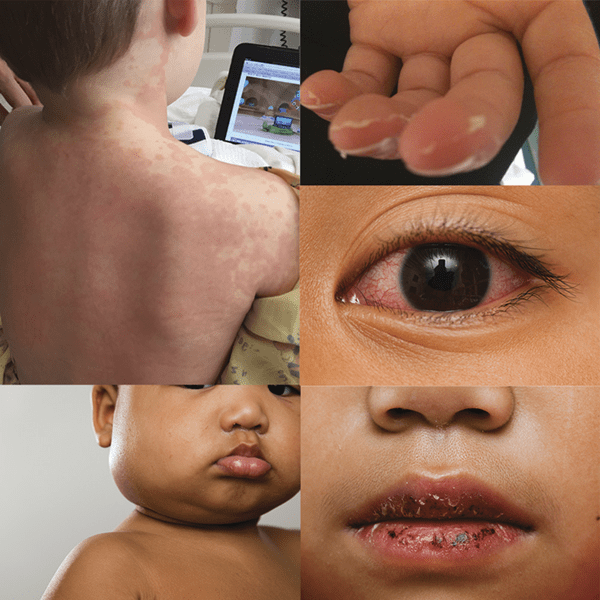
Many symptoms of Kawasaki Disease mentioned above.
(Photo taken from https://www.heart.org/en/health-topics/kawasaki-disease)


Leave a Reply